
Use this article to better understand your symptoms and options. An in-person podiatry evaluation is the best way to determine what is causing a specific foot or ankle problem.
You may feel fine when you first get out of a chair, only to notice an ache building through your arch as you cross a parking lot or walk through a store. Perhaps one foot tires sooner than the other, or you have started changing your stride without realizing it.
Arch pain when walking is often blamed on standing too long or wearing the wrong shoes. Those factors can certainly contribute, but they may not tell the whole story. How your foot meets the ground, absorbs pressure, and pushes you forward can affect the arch with every step.
Understanding that movement—your foot biomechanics—can help explain why the discomfort keeps returning and why the same solution does not work for everyone.
Your arch is part of a moving support system
The arch is not a rigid structure. It is supported by bones, joints, ligaments, muscles, and tendons that work together as your body moves over the foot. During a typical step, the foot adapts to the ground, helps absorb impact, and then becomes more stable so you can push forward.
A certain amount of inward rolling, known as pronation, is normal. It allows the foot to manage force. The foot then shifts toward a firmer position for propulsion. Problems can develop when this motion is excessive, poorly controlled, unusually limited, or different from one side to the other.
For example, a foot that rolls inward more than it can comfortably control may place added demand on tissues supporting the arch. A relatively rigid, high-arched foot may absorb shock less effectively and concentrate pressure in certain areas. Neither a low nor a high arch automatically means something is wrong. What matters is how that foot functions while bearing weight.
Why foot mechanics can change the way you walk
When the arch hurts, the body usually tries to protect it. You might shorten your step, shift weight to the outside of the foot, turn a foot outward, or spend less time on the painful side. These adjustments may be subtle, but repeating them throughout the day can affect other areas.
The ankle, knee, hip, and lower back all participate in walking. A change at the foot can influence movement farther up the leg, just as limited ankle motion or weakness around the hip can alter the pressure reaching the foot. This does not mean every knee or back complaint begins in the arch. It does mean that arch pain should be evaluated in the context of the entire walking pattern rather than only where it hurts.
Biomechanics also helps explain why two people with discomfort in the same location may need different approaches. One may have restricted ankle flexibility, another may overload the inside of the foot, and a third may be compensating for an old injury.
The pattern of arch pain provides useful clues
Where and when the pain appears can help narrow the possibilities, although symptoms alone cannot confirm a diagnosis. It is useful to notice whether the discomfort is close to the heel, centered through the arch, located along the inner side of the foot, or felt closer to the ball of the foot.
Pay attention to patterns such as:
- Pain with the first steps after rest that changes as you continue moving
- An ache that builds with longer periods of walking or standing
- Burning, tingling, or numbness rather than a simple muscle-like ache
- Tenderness or swelling along the inside of the foot or ankle
- Pain after increasing exercise, changing work demands, or wearing different shoes
- Discomfort that is consistently worse on one side
These details can point toward irritation involving the plantar fascia, tendons, joints, nerves, or other structures. A stress injury may also cause pain that worsens with weight-bearing. Because several conditions can feel similar at first, persistent symptoms deserve more than guesswork.
Common factors that can overload the arch
Arch discomfort is not always caused by a single event. It can develop when the amount of stress placed on the foot exceeds what its tissues are prepared to handle. A sudden increase in walking, running, or standing is one common example.
Worn or poorly matched footwear may contribute by changing support, cushioning, or pressure distribution. Tight calf muscles and limited ankle motion can make the foot compensate during a step. Muscle weakness, changes in body weight, hard working surfaces, and previous foot or ankle injuries may also influence loading.
Age-related changes can affect flexibility and tissue tolerance, but arch pain should not be dismissed as an inevitable part of getting older. Similarly, having flat feet or high arches does not by itself determine whether pain will occur. A podiatric evaluation considers structure, movement, symptoms, activity, and footwear together.
What you can reasonably try at home
If the discomfort is mild, began gradually, and is not associated with an injury or concerning symptoms, temporarily reducing the activity that aggravates it may help. That does not necessarily require complete inactivity. Shorter walks, fewer hills, or a lower-impact form of exercise may reduce repeated strain while allowing you to remain active.
Supportive shoes that fit well and are appropriate for your activity are generally preferable to badly worn shoes or unsupportive footwear. Avoid forcing a painful stretch or trying to “work through” increasing pain. Gentle calf stretching may be appropriate for some people, but exercises should not produce sharp pain, tingling, or worsening symptoms.
Over-the-counter inserts can sometimes improve comfort, but they are not a universal answer. An insert that changes pressure in the wrong way may be unhelpful for a particular foot type or condition. If you repeatedly depend on inserts without understanding the cause of your pain, an evaluation can clarify whether the issue is support, mobility, tissue irritation, an injury, or a combination of factors.
What a podiatrist looks for during a biomechanical evaluation
A useful assessment involves more than looking at the height of the arch. The podiatrist may ask when the pain began, what activities provoke it, whether there was a recent change in exercise or work, and which shoes feel better or worse.
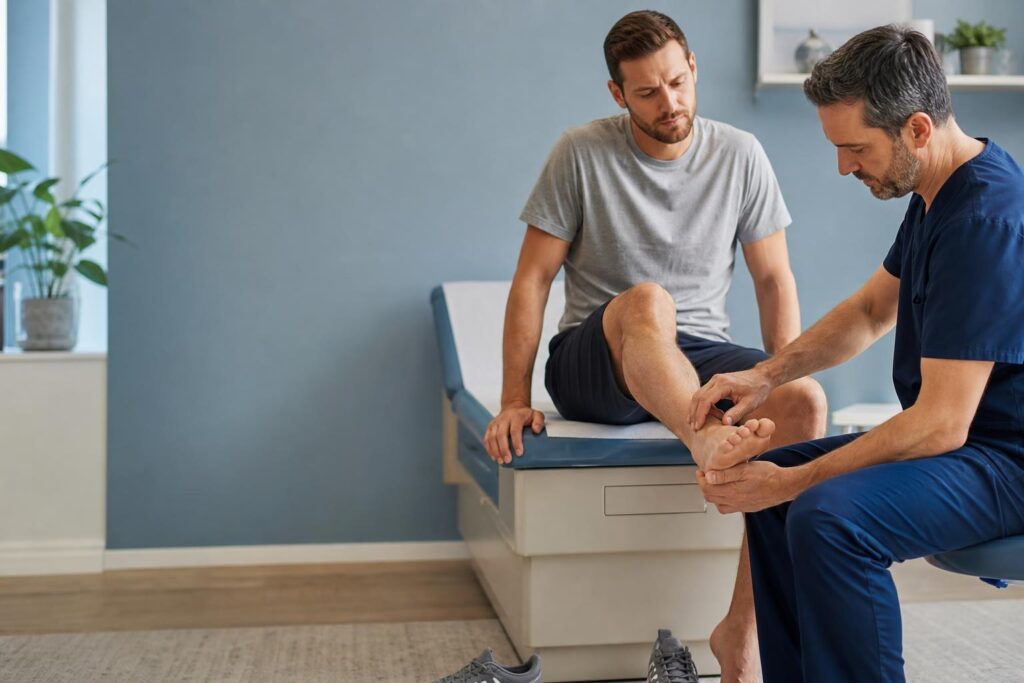
The physical examination may include the painful area as well as foot alignment, joint mobility, muscle strength, ankle flexibility, and signs of swelling or tissue irritation. Observing how you stand and walk can reveal whether the foot rolls inward or outward, whether one side moves differently, and how you transfer weight from heel to toe.
Imaging is not necessary in every case. It may be considered when the history or examination raises concern about a bone injury, joint problem, or another condition that cannot be adequately assessed through a physical examination alone.
Treatment depends on what the evaluation finds. Options may include activity modification, footwear guidance, targeted stretching or strengthening, padding, bracing, medication when medically appropriate, or orthotic support. More involved treatment may be considered when conservative measures are insufficient or a specific injury requires it. Dr. Brandwein provides comprehensive foot and ankle care based on the individual condition and walking demands.
When arch pain should be checked promptly
Arrange an evaluation if pain is recurring, worsening, changing your gait, or making routine walking difficult. You should also seek care after a significant injury or if you cannot comfortably bear weight.
More prompt medical attention is appropriate for severe swelling, visible deformity, marked redness or warmth, fever, an open wound, rapidly increasing pain, or a foot that becomes unusually pale, blue, cold, or numb. Sudden pain accompanied by a pop or an inability to push off the foot also warrants timely assessment. Emergency care may be appropriate for severe injuries or signs of impaired circulation.
People with diabetes, neuropathy, poor circulation, or a history of foot ulcers should be especially cautious about new pain, skin changes, blisters, or wounds. Do not rely solely on pain intensity, because reduced sensation can mask a developing problem. Learn more about the practice’s approach to diabetic foot care.
Take the strain out of each step
Arch pain can make an ordinary walk feel surprisingly demanding. If rest, shoe changes, or reduced activity have not solved the problem—or if the discomfort keeps returning—the next step is to determine how your foot is functioning and which tissues may be under stress.
Dr. Daniel Brandwein, DPM, PA, FACFAS, is a board-certified podiatrist who has provided podiatric care in Pompano Beach since 1991. To arrange an evaluation, visit the contact page or call (954) 984-7500. The office is located at 159 S Pompano Parkway, Pompano Beach, FL 33069. Same-day appointments may be available, walk-ins are welcome, and most insurance is accepted.
This article is intended for general education and does not replace an individualized medical evaluation.
Ready to Get Your Foot or Ankle Concern Checked?
If foot pain, a wound, nail problem, injury, or another concern is affecting your comfort or mobility, Dr. Daniel Brandwein can evaluate what is going on and discuss appropriate next steps.
Dr. Daniel Brandwein DPM, PA, FACFAS
159 S Pompano Parkway, Pompano Beach, FL 33069
(954) 984-7500
This article is for general educational information and is not a substitute for an individualized medical evaluation or treatment plan.
Get your foot or ankle concern properly evaluated.
Dr. Daniel Brandwein provides podiatry care in Pompano Beach for foot and ankle pain, diabetic foot concerns, nail problems, wounds, injuries, and other common podiatric conditions.