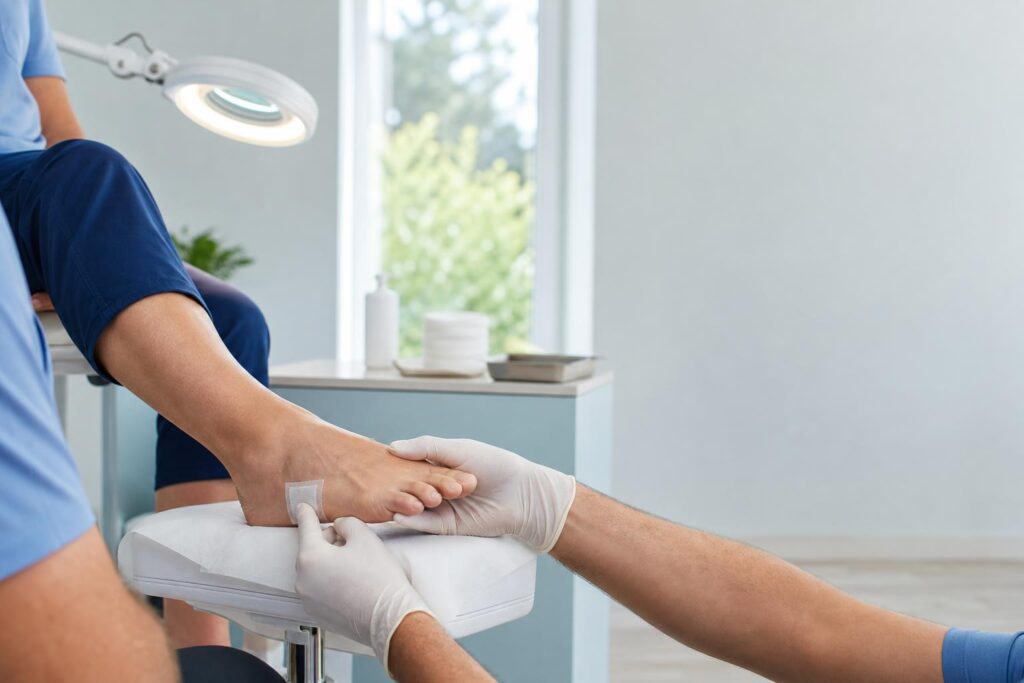

Use this article to better understand your symptoms and options. An in-person podiatry evaluation is the best way to determine what is causing a specific foot or ankle problem.
You notice tenderness along the side of your big toenail, followed by redness or swelling. Because the area looks irritated, reaching for rubbing alcohol may seem like a sensible way to clean it and prevent infection.
Unfortunately, alcohol does not correct the main problem: the nail edge pressing into or breaking the surrounding skin. It can also sting sharply and dry or irritate already-sensitive tissue. Whether home care is reasonable depends less on which antiseptic you use and more on how far the ingrown nail has progressed.
Here is how to care for a mild problem safely, recognize signs that the nail needs professional attention, and understand what a podiatrist may do to relieve the pressure.
Does rubbing alcohol help an ingrown toenail?
Rubbing alcohol can reduce some germs on intact skin, but repeatedly pouring it onto an irritated nail fold is not an effective treatment for an ingrown toenail. It cannot remove the embedded nail edge, change the way the nail is growing, or reliably treat an infection beneath the nail fold.
Alcohol may also dry the skin and cause burning, particularly if the nail has created a small opening. Hydrogen peroxide can be similarly irritating when repeatedly applied to damaged tissue. A product that produces a strong sensation is not necessarily helping the area heal.
If the skin is only mildly tender and has no drainage, gentle washing with soap and water is generally more appropriate than repeatedly applying harsh antiseptics. If there is pus, spreading redness, or an open sore, cleaning the surface is not a substitute for an evaluation.
Why the toe keeps hurting even when it is clean
An ingrown toenail develops when the side or corner of the nail presses into the adjacent skin. This can happen after trimming the nail too short or rounding its corners, wearing shoes that crowd the toes, injuring the nail, or simply because of the nail’s natural shape.
The pressure may initially cause tenderness only when the toe is touched or squeezed by a shoe. As irritation increases, the nail fold can become swollen and red. The skin may begin to grow over the nail edge, and bacteria can enter through a break in the skin.
That is why disinfecting the surface rarely solves a persistent ingrown toenail. As long as the nail edge continues to press into the tissue, pain and inflammation may continue.
What you can do for a mild ingrown toenail
Conservative care may be reasonable when the discomfort is recent and mild, the redness is limited to the nail edge, and there is no pus, open wound, or spreading inflammation. The goal is to reduce pressure and avoid creating additional injury while watching the toe closely.
- Wash the toe gently with soap and water, then dry it carefully.
- Try a brief warm-water soak to soothe the area, unless a clinician has advised you to avoid soaking your feet.
- Wear roomy shoes or open-toed footwear that does not press against the painful nail fold.
- Leave the nail corner alone. Do not dig underneath it with scissors, clippers, or another sharp object.
- Avoid cutting a V into the center of the nail. This does not redirect growth away from the painful edge.
- Do not tear off the corner or trim the nail deeply down the side, which can leave a sharp fragment behind.
Trying to force cotton, floss, or another object under a painful nail can also injure the skin or push material into an area that is already inflamed. A podiatrist can determine whether a lifting or splinting technique is appropriate and perform it without causing unnecessary trauma.
If pressure relief and gentle care do not produce clear improvement, continued home treatment may simply prolong the irritation.
Signs the ingrown toenail should be examined
You do not have to wait until the pain becomes severe. An evaluation is appropriate when the nail interferes with shoes or walking, keeps returning, or is not improving with basic care.
Contact a podiatrist promptly if you notice:
- Pus, cloudy drainage, an unpleasant odor, or ongoing bleeding
- Redness, warmth, or swelling that is increasing or spreading beyond the nail fold
- Throbbing pain or significant tenderness with light pressure
- Skin that appears to be growing over the nail edge
- A visible nail fragment embedded in the skin
- Pain that returns each time the nail grows out
- Difficulty wearing a shoe or walking normally because of the toe
Fever, red streaking, rapidly spreading redness, or feeling systemically unwell warrants prompt medical attention. Severe or rapidly worsening symptoms may require urgent care rather than waiting for a routine appointment.
Diabetes, neuropathy, and circulation problems change the plan
People with diabetes, reduced circulation, neuropathy, a weakened immune system, or a history of slow-healing foot wounds should not attempt to cut out an ingrown nail at home. Neuropathy can make an injury feel less painful than expected, while circulation and immune problems can affect healing and the body’s response to infection.
Even a small opening beside the nail deserves attention when these risks are present. Avoid soaking or applying chemical antiseptics unless your clinician has specifically recommended them. Arrange an evaluation rather than waiting for the toe to become more painful.
Patients and caregivers can learn more about the practice’s approach to diabetic foot care, including the importance of addressing skin and nail changes early.
What a podiatrist can do for a painful nail
A podiatry visit begins with examining the nail edge, surrounding skin, circulation, sensation, and any signs of infection. The clinician may also ask when the pain began, whether the problem has happened before, and what you have applied or attempted at home.
For an early case, treatment may focus on reducing pressure and guiding the nail edge as it grows. When the nail is embedded, a podiatrist may numb the toe and remove only the offending side of the nail. This is different from trying to carve out the corner at home: the nail segment can be removed under controlled, clean conditions while limiting injury to nearby tissue.
If ingrown nails repeatedly occur along the same border, a procedure may be considered to reduce the likelihood that the troublesome section grows back. The appropriate option depends on the nail, the condition of the skin, circulation, health history, and whether infection appears to be present.
Antibiotics are not automatically needed for every ingrown toenail. Removing the source of pressure may be central to treatment, while signs of a spreading skin infection may require additional care. An examination helps determine which approach makes sense rather than relying on the appearance of the toe alone.
More information about evaluation and treatment is available on the practice’s ingrown and fungal nail care page.
Reducing the chance of another painful nail
Once the toe settles, trim toenails mostly straight across and avoid cutting them shorter than the end of the toe. Smooth sharp edges gently rather than digging down the sides. Shoes should provide enough width and depth for the toes without pressing them together.
Persistent nail curvature, thickening, repeated trauma, or difficulty reaching the feet can make safe trimming more challenging. Professional nail care may be especially useful for older adults and people whose health conditions make small foot injuries more consequential.
Get help before the toe becomes harder to treat
Rubbing alcohol may make an ingrown toenail burn, but it does not remove the nail pressure responsible for the problem. If the toe is draining, increasingly red, repeatedly painful, or difficult to fit into a shoe, a podiatry evaluation can help determine the safest next step.
Dr. Daniel Brandwein is a board-certified podiatrist who has provided podiatric care in Pompano Beach since 1991. To request an evaluation, visit the contact page or call (954) 984-7500. The office is located at 159 S Pompano Parkway, Pompano Beach, FL 33069, and same-day appointments may be available.
Ready to Get Your Foot or Ankle Concern Checked?
If foot pain, a wound, nail problem, injury, or another concern is affecting your comfort or mobility, Dr. Daniel Brandwein can evaluate what is going on and discuss appropriate next steps.
Dr. Daniel Brandwein DPM, PA, FACFAS
159 S Pompano Parkway, Pompano Beach, FL 33069
(954) 984-7500
This article is for general educational information and is not a substitute for an individualized medical evaluation or treatment plan.
Get your foot or ankle concern properly evaluated.
Dr. Daniel Brandwein provides podiatry care in Pompano Beach for foot and ankle pain, diabetic foot concerns, nail problems, wounds, injuries, and other common podiatric conditions.