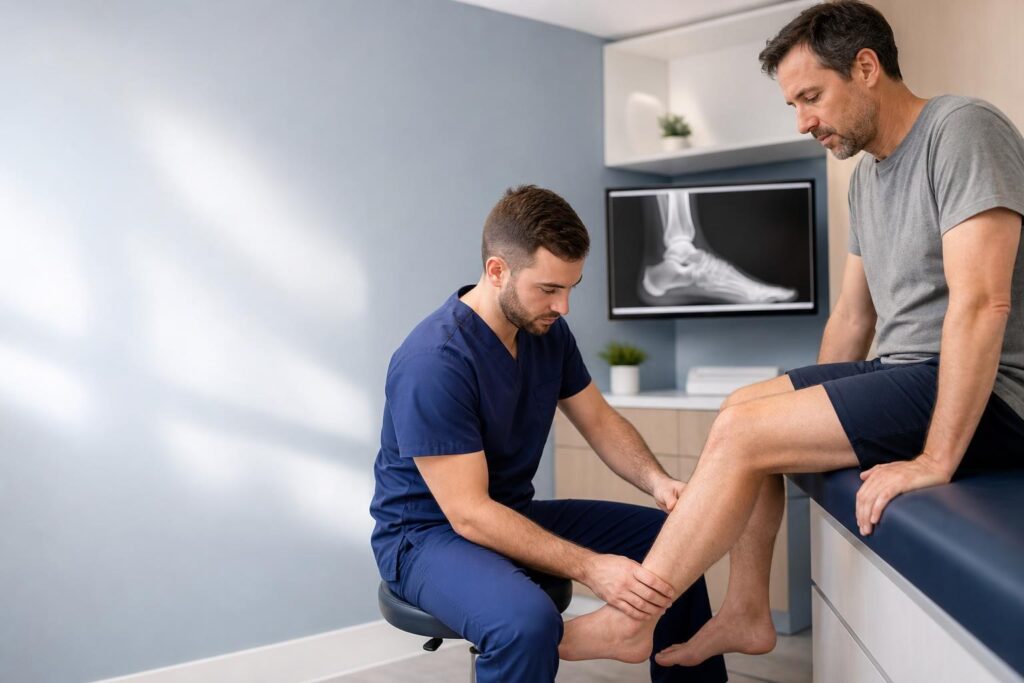

Use this article to better understand your symptoms and options. An in-person podiatry evaluation is the best way to determine what is causing a specific foot or ankle problem.
Your heel may feel fine while you are sitting, then hurt sharply the moment you stand. Or perhaps the first few steps are comfortable, but pain builds after a walk, a work shift, or a workout. Some people notice the discomfort only after they stop moving.
These differences matter. When heel pain appears—and how it changes with activity—can help narrow down which structures may be irritated. Timing alone cannot confirm a diagnosis, but it gives a podiatrist useful information and may help you make safer decisions while waiting for an evaluation.
Why the timing of heel pain can be a useful clue
The heel absorbs force every time your foot meets the ground. Its bones, connective tissue, cushioning pad, tendons, nerves, and nearby joints can respond differently to rest and repeated loading.
A tight or irritated tissue may hurt most when it first starts moving. A stress-related bone problem may become more noticeable as weight-bearing continues. A nerve-related issue may cause burning or tingling that does not follow a simple activity pattern.
Several heel conditions can also produce similar symptoms. That is why the pattern is best treated as a clue rather than proof that you have a particular problem.
Pain on the first steps in the morning
Heel pain that is strongest during the first few steps after getting out of bed is commonly associated with irritation of the plantar fascia, the band of tissue that runs along the bottom of the foot. The discomfort is often felt near the inner portion of the bottom of the heel.
A similar “start-up” pattern may happen after sitting through a meal, driving, or spending an hour at a desk. The pain may ease after several minutes of walking, only to return later in the day.
This pattern can point toward plantar fascia involvement, but it is not exclusive to plantar fasciitis. Tight calf muscles, changes in activity, unsupportive footwear, and altered foot mechanics can contribute. Morning stiffness in multiple joints or prolonged stiffness may also call for a broader medical assessment.
If first-step pain continues for more than a short period, repeatedly returns, or changes the way you walk, an evaluation can help determine what is being overloaded and whether treatment should address more than the painful spot.
Pain that builds during walking or exercise
When a heel feels reasonably comfortable at first but becomes increasingly painful with each mile, lap, or hour on your feet, repeated loading may be aggravating the area.
Possible contributors include plantar fascia irritation, Achilles tendon problems, heel pad irritation, or a bone stress injury. The location and character of the pain add important context. Pain at the back of the heel may involve the Achilles tendon or the point where it attaches to the heel bone. A deep, increasingly focused pain within the heel may require assessment for a stress-related bone injury.
Pain that builds with activity should not automatically be treated as something to “walk off.” Continuing to load an injured structure can prolong symptoms and, in some cases, make an injury more significant. This is especially relevant after a rapid increase in running, court sports, walking distance, hills, or time spent standing.
Dr. Brandwein provides evaluation and care for activity-related foot and ankle problems through the practice’s sports medicine and trauma services.
Pain that improves once you warm up—but returns afterward
Some heel pain fades as the body warms up. That improvement can be reassuring, but it does not necessarily mean the underlying tissue is ready for unrestricted activity.
Achilles tendon irritation, for example, may feel stiff or sore at the beginning of a walk or workout, become less noticeable during movement, and then ache afterward or the next morning. Plantar fascia symptoms may follow a similar cycle.
Pay attention to the response later that day and the following morning. If each activity session leads to stronger pain, longer stiffness, swelling, or reduced function, your current activity level may be exceeding the tissue’s ability to recover.
Bruise-like pain after standing on hard floors
A sore, bruised sensation in the center of the bottom of the heel may involve the heel’s natural cushioning pad. It can become irritated by prolonged standing, repetitive impact, hard surfaces, or walking barefoot on tile or concrete.
Heel pad discomfort often feels different from the pulling or stabbing pain people associate with the plantar fascia. It may be more centered under the heel and feel as though there is not enough cushioning between the bone and the floor.
Supportive, well-cushioned shoes may reduce pressure, but persistent pain still deserves attention. A podiatrist can examine the exact area of tenderness and consider whether another condition is creating a similar bruise-like feeling.
Heel pain at rest or during the night
Pain that continues when you are not standing follows a different pattern from straightforward activity-related soreness. Burning, tingling, electric sensations, or pain that radiates into the arch or ankle may suggest nerve irritation. Persistent night pain can have several possible causes and should not be self-diagnosed.
Arrange an evaluation if the discomfort regularly wakes you, is becoming more intense, or appears with numbness, unusual sensitivity, swelling, warmth, redness, or skin changes. People with diabetes, reduced sensation, circulation concerns, or a history of foot wounds should be especially cautious about new foot or heel symptoms.
Track more than the time of day
Before your appointment, note the timing of the pain along with a few other details. This can make it easier to explain the pattern accurately:
- Where the pain is located: under, behind, beside, or deep within the heel
- Whether it feels sharp, aching, burning, pulling, or bruise-like
- How many steps or minutes it takes to improve or worsen
- Whether there is swelling, stiffness, numbness, or discoloration
- Any recent change in exercise, work demands, shoes, or walking surfaces
- Whether you remember a sudden impact, awkward landing, or popping sensation
Also consider whether you are compensating. Limping, walking on the outside of the foot, or shortening your stride may shift stress into the ankle, knee, hip, or opposite foot.
What you can reasonably do while monitoring mild symptoms
For mild heel discomfort without a significant injury or concerning symptoms, temporarily reducing the activity that triggers pain may help prevent repeated irritation. Wear supportive shoes rather than going barefoot, particularly on hard floors. Avoid abruptly testing the heel with a long walk or intense workout just because it feels better after a day of rest.
Ice may be appropriate for some activity-related soreness, but it should be wrapped rather than placed directly against the skin. If you have reduced sensation, circulation problems, diabetes, or another health condition affecting the feet, ask a medical professional before using ice or starting home treatment.
Stretching is not right for every cause of heel pain. Aggressive calf or foot stretching may aggravate certain injuries, particularly when pain began suddenly or a tendon or bone injury is possible. An individualized assessment is safer than repeatedly trying online exercises without knowing which structure is involved.
When heel pain should be evaluated promptly
Seek prompt medical attention if heel pain follows a fall or sudden injury, you cannot bear weight, the foot looks misshapen, or you felt a pop near the back of the ankle and now have difficulty pushing off. Rapid swelling, spreading redness, significant warmth, fever, an open area, drainage, or a change in skin color also warrants timely care. Severe or rapidly worsening symptoms may require urgent or emergency evaluation.
For non-emergency pain, schedule an appointment when symptoms persist, keep returning, interfere with normal walking, or force you to reduce work or recreational activity. An examination can assess tenderness, motion, strength, walking mechanics, and footwear. Imaging may be considered when the history and examination suggest that it would provide useful information.
Get clarity about your heel pain pattern
Morning pain, pain that builds during walking, and pain that lingers at rest can overlap. The goal is not simply to attach a familiar label to the symptom, but to understand which tissue may be involved, what is placing stress on it, and what level of activity is appropriate.
This article provides general education and does not replace individualized medical advice. Dr. Daniel Brandwein has provided comprehensive foot and ankle care in Pompano Beach since 1991. If heel pain is changing the way you walk or is not settling down, you can schedule an evaluation at 159 S Pompano Parkway or call (954) 984-7500. Same-day appointments may be available, and walk-ins are welcome.
Ready to Get Your Foot or Ankle Concern Checked?
If foot pain, a wound, nail problem, injury, or another concern is affecting your comfort or mobility, Dr. Daniel Brandwein can evaluate what is going on and discuss appropriate next steps.
Dr. Daniel Brandwein DPM, PA, FACFAS
159 S Pompano Parkway, Pompano Beach, FL 33069
(954) 984-7500
This article is for general educational information and is not a substitute for an individualized medical evaluation or treatment plan.
Get your foot or ankle concern properly evaluated.
Dr. Daniel Brandwein provides podiatry care in Pompano Beach for foot and ankle pain, diabetic foot concerns, nail problems, wounds, injuries, and other common podiatric conditions.