
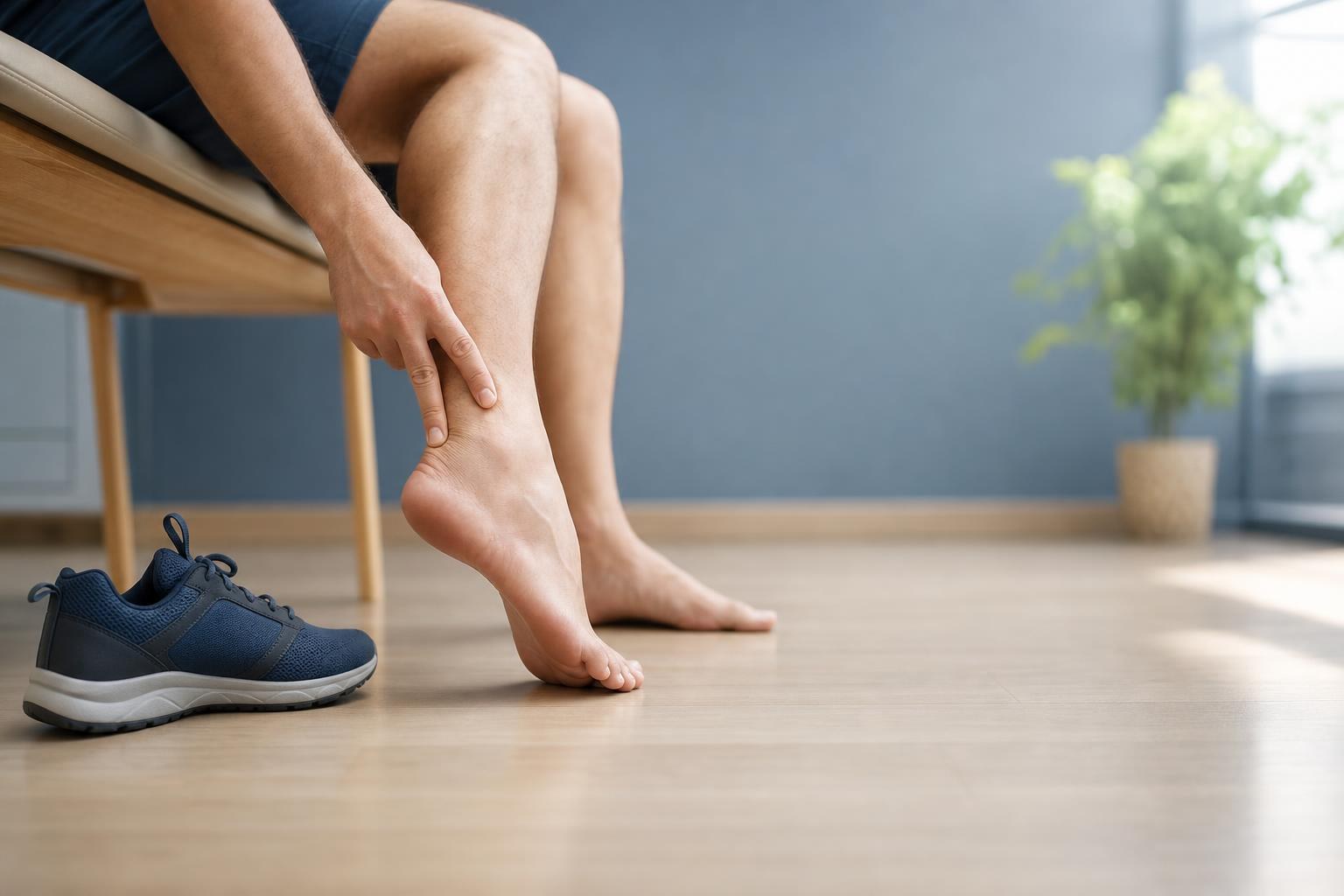
Use this article to better understand your symptoms and options. An in-person podiatry evaluation is the best way to determine what is causing a specific foot or ankle problem.
You know your heel hurts, but the description may seem frustratingly vague. Is it directly underneath, closer to the arch, behind the heel, or along one side? Does it stab during the first few steps of the morning, feel bruised whenever you stand, or burn even when you are resting?
Those details matter because “heel pain” is not one condition. The plantar fascia, heel pad, Achilles tendon, nearby bursae, nerves, and heel bone can all produce discomfort in the same small area. Although symptoms often overlap, the location and pattern of pain can provide useful clues about what may be irritated.
Why the exact location of heel pain matters
People often assume that pain under the heel must be plantar fasciitis or that a visible heel spur explains everything. In reality, two people pointing to nearly the same spot may have pain from different structures.
A podiatric evaluation looks beyond the painful point. Your walking pattern, footwear, recent activity, ankle flexibility, tenderness, swelling, sensation, and ability to push off can help narrow the possibilities. The timing also matters, but location is often a practical place to begin.
Pain underneath the heel: plantar fascia, heel pad, or bone?
Plantar fascia irritation
The plantar fascia is a strong band of tissue that runs from the heel toward the toes. When its attachment near the heel becomes irritated, pain often appears under the heel and slightly toward the inner side. It may be especially noticeable with the first steps after getting out of bed or standing after a period of rest. The discomfort can ease as the foot warms up and then return after prolonged standing or walking.
This pattern is commonly called plantar fasciitis, although ongoing cases may involve tissue degeneration rather than active inflammation alone. Tight calf muscles, abrupt activity changes, repetitive loading, and footwear may contribute, but no single factor explains every case.
Heel pad irritation
The natural fat pad under the heel cushions the bone during each step. Pain from this area often feels more like a deep bruise in the center of the heel. Hard floors, barefoot walking, thin-soled shoes, or repeated impact may make it more noticeable.
Unlike the classic first-step pattern associated with plantar fascia pain, heel pad discomfort may persist whenever weight is placed directly on the heel. The distinction is not always obvious without examining where pressure reproduces the symptoms.
Heel bone stress injury
A stress reaction or stress fracture of the heel bone can also cause deep heel pain. It may follow a sudden increase in running, walking, sports participation, or other weight-bearing activity. Pain typically worsens as activity continues and may eventually be present during ordinary walking.
Swelling and tenderness around the heel can occur, and squeezing the sides of the heel may be uncomfortable. Because continued loading can aggravate a bone injury, worsening pain after an activity increase should not automatically be treated as plantar fasciitis. An evaluation can help determine whether imaging or temporary activity restriction is appropriate.
Pain behind the heel: Achilles tendon or nearby irritation?
Insertional Achilles tendon pain
The Achilles tendon attaches the calf muscles to the back of the heel bone. Irritation where the tendon meets the heel can cause pain, stiffness, or thickening at the back of the heel. Hills, stairs, running, and pushing off may be uncomfortable. Some people notice morning stiffness, which can make this problem seem similar to plantar fascia pain despite its different location.
Shoes with firm heel counters may press directly on the tender area. An abrupt training change or tight calf muscles may also contribute. Treatment choices can differ from those used for pain under the heel, so locating the symptoms precisely is important.
Bursitis and shoe pressure
Small fluid-filled sacs called bursae help reduce friction around the back of the heel. Irritation in this region may cause localized redness, swelling, or tenderness, particularly where a shoe rubs. A prominent area of bone can add pressure, but the prominence itself does not reveal which tissue is generating pain.
Persistent posterior heel pain—especially after a sports injury—can be assessed through the practice’s sports medicine and trauma care.
Pain along the inner or outer heel: nerves and surrounding structures
Pain near the inner heel may still come from the plantar fascia, but burning, tingling, electric sensations, or numbness can suggest nerve involvement. A nerve may be irritated near the ankle or farther up the leg. Occasionally, pain felt in the heel is referred from another location rather than originating in the heel itself.
Outer heel pain can develop when a person shifts weight away from another sore area, after an ankle injury, or when nearby tendons and joints are overloaded. Compensation may provide short-term relief while creating a second painful area. That is why examining how the entire foot and ankle move can be more informative than treating the heel in isolation.
Common heel pain mix-ups
Several assumptions can make it harder to identify the source of persistent symptoms:
- “Morning pain always means plantar fasciitis.” First-step pain is a helpful clue, but Achilles problems and other stiff, irritated tissues may also hurt after rest.
- “A heel spur must be causing the pain.” Bone spurs can exist without symptoms. Finding one on an X-ray does not automatically prove that it is the pain source.
- “All pain under the heel needs more stretching.” Stretching may be useful in some cases, but aggressive stretching is not appropriate for every tendon, nerve, or bone problem.
- “If I can walk, the injury cannot be serious.” Some stress injuries and tendon problems still allow walking, particularly early on.
A focused examination helps connect the symptom pattern with the involved structure. Dr. Brandwein provides comprehensive foot and ankle care for heel, arch, and other lower-extremity concerns.
What you can do while monitoring mild heel pain
If the pain is mild, there was no significant injury, and you can walk normally, reasonable short-term steps may include reducing the activity that provokes it, avoiding barefoot walking on hard surfaces, and wearing supportive shoes that do not rub the sore area. Brief, protected cold application may help after activity if swelling or soreness is present.
Avoid pushing through escalating pain or repeatedly testing the heel with the activity that triggered it. Also be cautious about copying a treatment plan based only on someone else’s diagnosis. A stretch or insert intended for plantar fascia irritation may not address a heel pad, nerve, tendon, or bone problem.
Arrange an evaluation if pain keeps returning, changes your gait, limits work or exercise, or fails to improve with sensible activity changes. Earlier assessment may also be appropriate if you have diabetes, reduced sensation, poor circulation, or a history of foot ulcers.
When heel pain needs prompt attention
Seek prompt medical care after a fall, hard landing, or direct blow if you cannot comfortably bear weight, have substantial swelling or bruising, or notice a change in the shape of the foot or ankle. A sudden pop behind the ankle followed by weakness or difficulty pushing off may indicate a significant Achilles injury and should be evaluated promptly.
Redness, warmth, rapidly increasing swelling, drainage, an open area, fever, or severe pain that seems out of proportion also warrants timely attention. People with diabetes or reduced sensation should not wait for a blister, crack, or pressure area around the heel to become painful before seeking care.
Getting the right evaluation for persistent heel pain
A heel examination may include checking the exact tender area, ankle motion, calf flexibility, strength, sensation, footwear, and walking mechanics. Imaging is not necessary for every case, but it may be recommended when the history or examination raises concern about bone injury, significant tendon damage, or another condition that cannot be clarified through examination alone.
This information is educational and cannot identify the cause of an individual reader’s symptoms. If heel pain is persistent or affecting the way you walk, Dr. Daniel Brandwein, DPM, PA, FACFAS, can evaluate the full pattern and discuss appropriate next steps. The practice has served Pompano Beach since 1991 at 159 S Pompano Parkway. Call (954) 984-7500 or use the contact page to request an appointment. Same-day appointments may be available, walk-ins are welcome, and most insurance is accepted.
Ready to Get Your Foot or Ankle Concern Checked?
If foot pain, a wound, nail problem, injury, or another concern is affecting your comfort or mobility, Dr. Daniel Brandwein can evaluate what is going on and discuss appropriate next steps.
Dr. Daniel Brandwein DPM, PA, FACFAS
159 S Pompano Parkway, Pompano Beach, FL 33069
(954) 984-7500
This article is for general educational information and is not a substitute for an individualized medical evaluation or treatment plan.
Get your foot or ankle concern properly evaluated.
Dr. Daniel Brandwein provides podiatry care in Pompano Beach for foot and ankle pain, diabetic foot concerns, nail problems, wounds, injuries, and other common podiatric conditions.